Cities
Paris after dark
Paris after dark, hour by hour: Pigalle, the Marais, the 8th, Saint-Germain and Oberkampf, the last Métro, and what the 2016 law means for a client.
7 min read
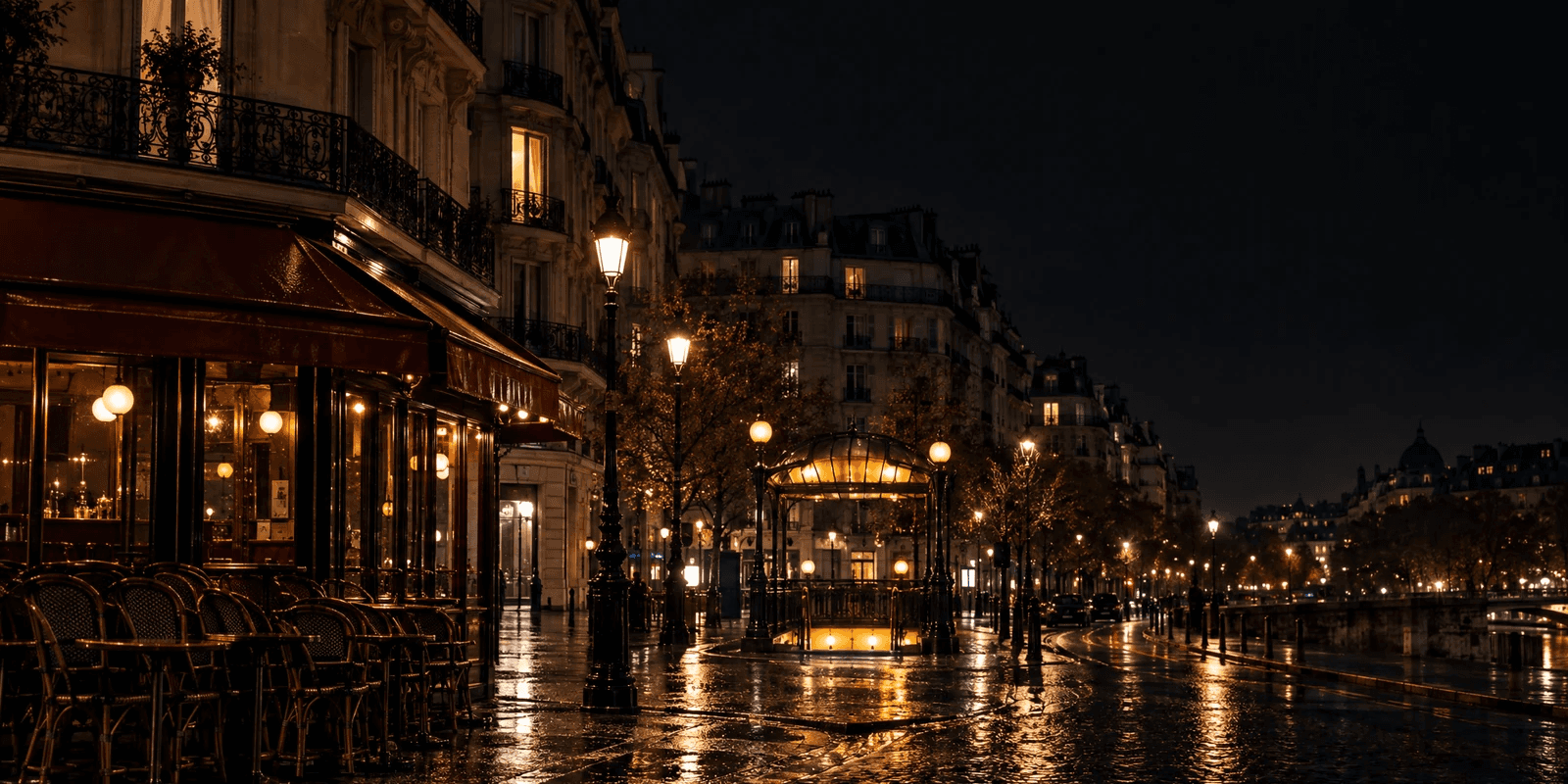
Paris after dark runs on a late start and a hard stop. Dinner rarely begins before half past eight, the bars fill around eleven, most of them close around two, though some stay open later, and the last Métro takes a good share of the city home not long after one on a weekday. What is left after that belongs to the clubs, the night buses and whoever planned ahead. The districts divide the evening between them: Saint-Germain for the early part, the 8th for money, the Marais for company, Pigalle and Oberkampf for the hours after midnight. And since 2016 the law here has a clear view about the person paying, which is the first thing a visitor from London tends to get wrong.
How the Paris night is shaped, hour by hour
Seven to nine is the apéro, and Paris takes it seriously. A terrace, a glass of something cold, a plate of something small, and the long business of watching the street go past. It is also the hour of the cinq à sept in its literal sense, the French name for the early-evening rendezvous before everyone goes home to dinner. Which home, and whose dinner, the phrase has always declined to say.
Dinner runs from half past eight to eleven, and nobody hurries it. Restaurants that turn a table twice in an evening are the exception, not the rule. This is why a Paris night feels slow to start: the city is still eating at the hour London is calling last orders.
Between eleven and two the bars do their work. Most hold licences that take them to two in the morning, and at two the pavements fill with people deciding what happens next. Then the choice narrows. The clubs, which typically run until five or later, sit mainly in Pigalle, around the Grands Boulevards, and out towards the 11th. The Rex Club on the boulevard Poissonnière has been running electronic nights for decades.
At five, Paris does something other cities do not: it goes to a café. The first Métro trains run from around half past five, the zinc counters open early, and a coffee and a croissant at a bar near a station is how a large part of the city’s night officially ends.
The last Métro, and getting home
This is the practical paragraph, so it is plain.
The Métro does not run all night. Last trains leave their terminus stations at about twenty to one from Sunday to Thursday, and about an hour later on Friday and Saturday nights and on the eve of public holidays. Times vary by line and by station, and engineering works change them, so check the line you need before the evening rather than at the platform. After the last train, the Noctilien night bus network covers the city and the suburbs until the trains start again. Taxis and ride-hailing fill the gap at a price that can rise sharply late at night.
The districts, and what each one is for
Pigalle and Montmartre. The boulevard de Clichy is where Paris kept its reputation for a century, and part of it still trades on that: the Moulin Rouge, the neon, the sex shops in a row. But the streets running south, the area now sometimes called SoPi, have turned into one of the city’s densest clusters of cocktail bars and small restaurants. La Cigale and Le Trianon on the boulevard de Rochechouart put concerts on most nights. Up the hill, Montmartre is quieter and more beautiful than it needs to be, and Sacré-Cœur at midnight with the city below is the one tourist image that earns its place. Pigalle is where the night likes to be looked at.
The Marais. The 3rd and 4th arrondissements, rue des Archives, rue Vieille-du-Temple, rue des Rosiers. For decades the Marais has been the heart of gay Paris, and on a warm Friday the pavements outside its bars are the most sociable stretch of the city. It fills early, stays crowded and never quite loses its manners, which is the Marais all over: generous with its attention, not careless with it.
The Champs-Élysées and the 8th. The Golden Triangle, between the avenue Montaigne, the avenue George-V and the Champs-Élysées itself, is where Paris keeps its money. The palace hotels hold the evening here: the Plaza Athénée on the avenue Montaigne, the George V, Le Bristol on the rue du Faubourg-Saint-Honoré, and the Crillon on the place de la Concorde. The Crazy Horse cabaret on the avenue George-V has been in the same business since 1951. The register is polished, discreet and largely finished by two, and the avenue itself after midnight is more neon than glamour.
Saint-Germain. The 6th does the early evening better than anywhere. The Café de Flore, Les Deux Magots and the Brasserie Lipp on the boulevard Saint-Germain trade on a literary past they never let you forget, and they are right not to. After midnight the district turns residential and calm. If the night you want starts at one, it starts somewhere else.
Oberkampf and the Canal Saint-Martin. The 11th and the 10th are where Paris goes out without dressing for it. The rue Oberkampf and the rue Jean-Pierre-Timbaud are lined with bars, Café Charbon among the oldest, and the crowd is younger, louder and later. In summer the edges of the Canal Saint-Martin along the quai de Valmy and the quai de Jemmapes turn into one long, informal picnic that runs well after dark.
Paris and privacy
France protects private life in law, and means it. Article 9 of the Civil Code gives everyone the right to respect for their private life, and French courts enforce it against magazines that publish what they should not. The image right means a person photographed in a private setting can object to the picture being published.
Socially the habit is the same. The French press long kept a polite distance from the private lives of the powerful, and the culture still treats curiosity about who is with whom as slightly vulgar. Hotel staff in the 8th do not ask. The neighbouring table pretends not to have heard, and usually has.
The comparison with London after dark is instructive: London logs more and says less, Paris does both less. New York after dark is the opposite case, a city where being seen is the point.
The legal position in France
This section is plain on purpose.
Since the law of 13 April 2016, paying for sex is an offence in France. The client commits it, not the person selling. The offence covers soliciting, accepting or obtaining sexual relations in exchange for payment, a promise of payment or a benefit in kind:
- A first offence is punished by a fine of up to 1,500 euros.
- A repeat offence becomes a more serious offence, with a fine of up to 3,750 euros.
- A court can add an awareness course on the purchase of sex, at the offender’s expense.
- Paying a minor or a particularly vulnerable person carries far heavier penalties, including prison.
The same law repealed the offence of soliciting, which had applied to people selling sex in public. Selling sex is not an offence. Pimping remains a serious crime and is defined broadly in French law: helping, profiting from or providing premises for the prostitution of another person can all fall within it. Brothels have been illegal in France since 1946.
In July 2024 the European Court of Human Rights ruled in M.A. and Others v. France that the 2016 law did not violate the right to private life, leaving the choice to national authorities.
The above is a summary of the law as it stands in October 2026, not legal advice, and nothing on this site is. How we handle legal summaries is set out in our editorial standards, and the terms used here are defined in the glossary.
Manners, and what Paris notices
Paris forgives most things except carelessness. Say bonjour when you walk into a bar, because it is not optional. Dress one notch above what you think the room requires. Do not raise your voice on a terrace. The wider rules of conduct are in our guide to etiquette, and the money side has its own page in what a night costs.
Paris does not hurry you and does not wait for you either. It simply assumes you know what time the last train leaves, and what you mean to do if you miss it.
Frequently asked questions
- Is paying for sex legal in Paris?
- No. Since the law of 13 April 2016, paying for sex has been an offence in France. A first offence is punished by a fine of up to 1,500 euros, rising to 3,750 euros for a repeat offence, and a court can add an awareness course at the offender's expense. Selling sex is not an offence, and the old offence of soliciting was repealed by the same law. Pimping and brothel-keeping remain crimes. This is a summary of the legal position, not legal advice.
- What time does the last Métro leave in Paris?
- Roughly, the last trains leave their terminus stations around twenty to one from Sunday to Thursday, and about an hour later on Friday and Saturday nights and on the eve of public holidays. Exact times vary by line and change with engineering works, so check the line you need. After that the Noctilien night buses run until the first trains, which start at around half past five.
- What is the difference between Pigalle and the Marais at night?
- Pigalle is the old red-light district reinvented: cocktail bars, concert halls and the Moulin Rouge sharing the boulevard with what remains of the trade it was named for. The Marais is the historic heart of gay Paris, denser, more sociable and earlier to fill. Pigalle is where the night goes to be looked at; the Marais is where it goes to talk.